Showing posts with label popular culture. Show all posts

Thursday, 7 January 2010

Holiday reading: Bringing Home the Birkin

The basic black Birkin.


Over Christmas i read Michael Tonello’s Bringing Home the Birkin (New York: Harper, 2009) which demystifies the most famous and most expensive handbag – the Hermes Birkin – as much a Holy Grail of luxury as it is a pop culture icon with prices as high as $60,000. A light read but significant in it’s exposing of the marketing myths of luxury brands and their inculcation of consumer desire based on false information. The Birkin probably entered popular culture in the late 1990s when Sex and the City (and later in episodes of the Gilmore Girls, Will and Grace and Gossip Girl) devoted an episode to the most coveted of bags and its notorious waiting list. There are even blogs devoted to random Birkin spotting. My first awareness of the brand name Hermes was the film Basic Instinct in 1992; Sharon Stone’s character uses Hermes scarves to tie her victims to the bedstead. She was a classy killer. The Birkin is copied the world over, often spoken of in relation to the smaller Hermes Kelly Bag (named after Grace Kelly) and mistaken for the larger Hermes Haut a Courrois which was originally for transporting horse saddles as befits the company’s 19th century origin. The Birkin name came about when on a flight sometime in 1984 Jane Birkin was seated next to the CEO of Hermes Jean-Louis Dumason when she bemoaned the need for more space in the Kelly and a design collaboration ensued.

Tonello’s book is as much a story of ebay entrepreneurship as it is the story of how he managed to procure hundreds of the impossible to purchase Birkin bags and sell them on for substantial profit. Anyone who has sold through ebay will recognise the same travails of online selling. Tonello explodes two pop culture fashion myths – firstly, the waiting list and secondly Hermes own claims to producing a limited number of Birkins a year. Even if you have the money to buy an entry level Birkin you can’t just go in to a Hermes store and buy one. It doesn’t work like that since it is the unobtainability that amplifies their desirability. You will be told that there’s a waiting list of approximately two years and that’s even if they bother to ever call you back. However, Tonello discovers what he calls ‘the formula’ for getting the Birkin in nearly every Hermes store he visits. His formula for a ‘same day Birkin’, one that bypasses the waiting list and thus reveals it as a fallacy, is buy lots of scarves and leather goods first, spending a few thousand, and then casually drop into conversation asking if they have any Birkins. With that first offering at the luxury altar the Hermes sales assistant (which he breaks down in to five stereotypes and how to deal with them) disappears in to the back of the shop and magically produces a Birkin. The profit on a Birkin re-sell is so high that Tonello is able to fly the world in search of more Birkins for rich American women and, exposing another fallacy, he alone manages to acquire more than the supposed annual production that the Hermes spiel suggests. In the end Tonello tires of the travel, Hermes and the world of luxury goods and no doubt Hermes cottons on and changes its tactics of sale when it comes to keeping the Birkin shrouded in legends of unobtainable.


Product placement: Carrie Bradshaw appears in Season 6 (Episode 16 - 'Out of the Frying Pan') of Sex and the City holding a Rouge H 30cm Matte Crocodile Birkin.

(photo credits: yumyumcherry; DVD screen grab; permissions)


Thursday, 23 July 2009

The End of an Era? Graduation 2009


Congratulations to the last cohort of graduates from the BA (hons) Media & Cultural Studies at Nottingham Trent University who were awarded their degrees at yesterday's graduation ceremony. Our congratulations also go to those students who received their Joint Honours degrees in Media & Cultural Studies.

This is also quite a sad day for those of us who developed and worked on the degree as it feels like the end of a particular chapter of our history. As the first course leader back in 1996, I am perhaps one of the people who feels this particularly keenly. Back then our degree marked a new stage in the development of cultural studies at NTU, taking the traditional strengths in textual analysis and combining them with a new emphasis on lived practice and everyday life. However, these interests live on in the new BA Media which started in 2007, most obviously in the pathway in Popular Culture. And, of course, cultural studies also lives on in our research which is perhaps less easily shaped by market forces. (Or maybe not? But my opinions about the media-ization of cultural studies as a field are perhaps best left for another day!)

So along with our congratulations, we wish this year's graduates the very best of luck with their future. And we'd like to take the opportunity to extend our thanks and our best wishes to those graduates throughout the degree's history.

Monday, 6 July 2009

Re-Reading a scene from Red River

Retrospectatorship after Brokeback Mountain

Patricia White in her book unInvited proposes the concept of retro-spectatorship. Retro-spectatorship is a way of negotiating the history of Hollywood through contemporary practices of spectatorship and the identities and cultural politics we now bring to our viewing of the past. Through retro-spectatorship, Brokeback Mountain solicits us to re-view the classical Hollywood western ‘that belongs to the past but is experienced in a present that affords us new ways of seeing’ (97). Therefore, as a contemporary western Brokeback Mountain’s helps us to shape a retrospective reading of older westerns, particularly those westerns such as Red River and Calamity Jane that have either struggled to disavow their homoerotic underpinnings or made obvious a range of queer possibilities. Its not that re-reading the classic western is an appropriating practice or subversive re-imagining rather, no reading of the text is the correct one its just that straightness is the default position of culture that we have all some point internalised as a practice. The point here is that Brokeback Mountain answers the call to all those elided and hinted at stories of same sex desire in the Hollywood western by retrospectively prompting a return back to films like Red River from a vaulted position of contemporary spectatorship. Brokeback Mountain engenders a privileging of being able to un-think assumptions about westerns in relation to sexuality. As Patricia White brilliantly demonstrates in her re-reading of lesbianism in classical Hollywood cinema, our spectatorial vantage point as queer subjects is steeped in knowingness about how Hollywood edited out homosexuality and cast it to the realm of the merely connotative. D. A. Miller in his analysis of Hitchcock’s Rope, suggests that the eliding of homosexuality’s denotation ‘exploits the particular aptitude of connotation for allowing homosexual meaning to be elided even as it is also being elaborated’ which, explains how homosexuality by its absence is made meaningful throughout classical Hollywood cinema.

A contemporary viewing of Red River, armed with the knowledge that one of its central stars Montgomery Clift was gay, provides the insight that retrospectatorship reveals in the films homoerotics that are barely contained in ‘the shadow kingdom of connotation’. (Miller: 125) The spectator’s first introduction to Montgomery Clift’s as the Matthew Garth character is startling in its invitation to look at his handsome boyish looks, standing aloof he seems to be gazing down towards John Wayne’s crotch while sucking on a piece of straw (shot 1).


Shot 1

The camera cuts from the medium shot to a close-up of Clift’s face as he looks towards Wayne that instantly constructs him in relation to a relay of desiring looks. In the facial close-up Clift looks on, tonguing the single piece of straw that dangles from his mouth.(Shot 2 and 3) The shot of Clift’s face seems to linger for an extra beat but it’s the minor detail in the piece of straw where a queer reading of Clift’s body and performance values such minutiae as it suddenly jumps out retrospectively as a signifier of Clift’s queerness, his character’s desire for Wayne and our desire for him. He plays with the piece of straw in a way that hints and suggests sex, an oral tease, delicately phallic but undeniable in its capacity to be read as homoerotic.


Shot 2


Shot 3

Steve Cohan also discusses Clift’s performance in Red River describing how he ‘uses physical gestures to draw attention to his presence in a shot, rubbing his face, caressing his nose, holding his chin, sitting side-saddle on his horse’ to the extent that it ‘implies Matthew’s passivity as erotic spectacle’. (216) Cohan’s reading of film emphasis ‘the trope of boyishness’ in Montgomery Clift in contradistinction to the manliness of John Wayne as the film sets out working through its opposition between the soft boy and the hard man. Clift’s softness in Red River helps to define his erotic appeal and Cohan points out that its precisely this aspect of his performance which challenges the hegemonic forms of masculinity typified in the film by John Wayne.

References
Steve Cohan (1997) Masked Men: Masculinity and the Movies in the Fifties. New York and London: Routledge
D. A. Miller (1991) ‘Anal Rope’ in Diana Fuss (ed) Inside/Out: Lesbian Theories, Gay Theories. London and New York: Routledge.
Patricia White (1999) unInvited: Classical Hollywood Cinema and Lesbian Representability. Bloomington and Indianapolis: Indiana University Press.


(Images: screen grabs; permissions)

Tuesday, 16 June 2009

"Macho Types Wanted: Must Dance And Have A Moustache"

While researching my book on Brokeback Mountain I am also exploring the multiple connections between the western (as a genre) and the West (as a mythic concept) in relation to gay culture. The concept of the West as a space of homosocial freedom and the fantasy of the cowboy are ongoing fascinations and it’s interesting how they are transformed and made meaningful in relation cultural identity. ‘The West’ in US gay culture is also a reference to the movement Westward to California in the 1970s, San Francisco in particular, and is a migratory moment resonant in the history of American post-Stonewall gay male identity; it’s the implicit subject of Armistead Maupin’s Tales of the City series and the recent film Milk. This idea also finds its widespread expression in the Village People’s over-exposed disco anthem Go West (1979) that explicitly connects discourses of liberation and self-discovery with the movement Westward, in fact, their very first release was titled San Francisco (You got Me). Go West reworks the nineteenth century expression ‘go west young man’ coined by US politician and newspaper editor Horace Greeley. While the sentiment of Greeley’s phrase is rooted in colonial conquest and expansion in the move Westward along the Mississippi River, the Village People’s lyrics instead signify that other movement of men West, the so-called 1970s ‘gay flight’. However, the Village people are a rather problematic group when it comes to sexual politics and it’s a misnomer to think of them as in any way ‘a gay band’ or even properly representative of disco despite their self-conscious fashioning through the iconography of gay machismo and the four-to-the-floor beat. The genesis of the band was a response to an advert in a music paper that read "Macho Types Wanted: Must Dance And Have A Moustache". As an eventual pop realisation of disco the Village People were eschewed by gay culture proper and would rarely if ever be heard in the legendary discos because the Village People was actually a bit naff and rather embarrassing. More importantly, the Village People were often tight lipped on homosexuality in interviews (most of them it turns out were straight) despite being sold as an idolatory vision of popular gay macho stereotypes. Thus, despite being explicitly if parodisitic in their visual presentation of gayness and macho vocal posturing, a band name that alludes to New York’s Greenwich Village, and suggestive lyrics focusing on gay culture (Cruisin') and gay positive expressions (I am what I am), the Village People’s apparent homosexuality (which I imagine is axiomatic of how most people interpret the act) was nothing more than smoke and mirrors with good musical production.

The meaning of the Village People’s later songs were expressed in a double-voiced strategy (lyrics mean different things to different people) but the group were certainly anchored through the stereotypical way in which different iconic forms of American masculinity such as the cowboy become a fancy dress version of gay erotica in popular culture writ large. However, when images of cloned up cowboys are couched in lyrics that celebrate the West as a gay utopia it continues to foment the West and the cowboy through liberation and freedom. California was the new frontier for gay America and it just so happens that some of those men were free to dress in ways that channel the apparent freedom the cowboy represents recasting the horizon as a sexual frontier. What is important here is that the Village People’s song that suggests going West ‘where the air is free, we'll be what we want to be’ is grounded in discourses of the West and the cowboy thus bringing together a historical moment in American post-stonewall gay identity, the continuing movement of men westward, and an ongoing tradition of a male-male relations in Western lore. Furthermore, this western dance music fantasy continues well after disco to include Divine’s Walk Like A Man (1984) Erasure’s Who Needs Love Like That (1985), and more recently the knowingly homoerotic rodeo styling (clothes by Dsquared - S/S 2006 picture below) of Madonna’s Don’t Tell Me (2000).

(Image Credits - Casablanca Records; Dsquared; Permissions)


Saturday, 30 May 2009

Goldilocks (aka Amanda Holden) and the Three Bears.

Last night (Friday 29th) I was privy with millions of other television viewer’s to a camp spectacle on ITV’s Britain’s Got Talent. This spectacle was called The Dreambears. Three twenty-something chubby gay men camping about on stage doing all manner of pirouettes, arrières, and changement de pieds; all this is choreographed to the Weather Girls Its Raining Men. Why is it worth blogging about? My answer is not The Dreambears attempt at ballet (or burlesque or Bob Fosse) which of course is fine rather, I’m bothered by the way in which prime-time television negotiates and mutes the subcultural aspects of their bear-ness in order to make gayness hyper-legible to the audiences through terms they are more familiar with. The Dreambears are not off the hook either since they are in part complicit in their own camp debasement as the first prime-time bears. This legibility in their performance is achieved through the erasure of the bear’s subcultural aspects that then work to contain the potential of bear masculinity to be viewed as completely ordinary, unfussy, and ultimately boring for TV. The way Britain’s Got Talent erases the bear, except in name, was manifold in three strategies that disrupt the bears’ literal masculine definition of themselves as the man’s man version of gayness. Here are a few observations.

Strategy 1. Make them look as camp as possible. Dress all the bears up as Daffyd from Little Britain in ultra tight PVC shorts and sparkly union jack vests. The Dreambears mention the costume department’s role in bringing us this tired vision. As an extra note one should observe that known gay presenters on television (the BBC holy trinity of Graham Norton, Dale Winton and John Barrowman) are compelled to wear sparkly, glittery, reflective, and garishly patterned suits as a semiotic articulation of their prime-time gayness which otherwise remains unspeakable.

Strategy 2. Deal with their fatness. Since the bear’s chubbiness is considered to be erotically appealing within the subculture it’s important to disavow this central aspect of bear identity by making them look silly as fat bodies out of place. Put them in camp outfits five sizes too small and make them do ballet that ought to do the trick. Did I mention that the connection to the Weather Girls It’s Raining Men is not just about music also but also corpulent excess?

Strategy 3. It’s really got nothing to do with sex. Bear subculture is also predicated on a sexual hierarchy based on age, size and ways of communicating within those hierarchized relations through terms such as ‘daddy’ and verbs like ‘to paw’ and ‘to maul’. In the first instance, The Dreambears look like cubs to me and have not yet graduated to being fully-fledged big daddy bears. If you didn’t know already bears tend to be stout gay men, preferable hirsute but not essential, accommodating of a wide but hierarchical age range (which is then divided into cubs, otters, wolves, polar bears etc). An oversimplification of their self-promotion would suggest that bears often shun the apparent narcissistic, sissified, slender, fashionable, and consumption-led gays that have often come to represent the stereotypical gay as if bears themselves were not just as regulated as the next queer.


What ITV’s strategies do here (but not forgetting the complicity of The Dreambears) is to work against the potential for these prime-time bears to destabilize normative assumptions between certain alignments of homosexuality and masculinity. In turn, Britain’s Got Talent confirms what people already think they know about homosexuality on television, light entertainment in particular, that is, its only meaningful and acceptable as risible de-sexed camp spectacle (with soaps being the alternative). Something Richard Dyer once wrote is applicable here – “In taking the signs of masculinity and eroticizing them in a blatantly homosexual context, much mischief is done to the security with which ‘men’ are defined in society, and by which their power is secured” (167). It’s precisely this potential for mischief that Britain’s Got Talent attempts to contain in its camping up and desexualisation of a modern gay subculture.

Though Amanda Holden does make a good Goldilocks!


Reference: Richard Dyer (1992) ‘Getting over the rainbow’ in Only Entertainment. London: Routledge.

(Photo credits: frame grab; pinups mag; permissions)

Tuesday, 14 April 2009

The culture and politics of roller-skating. (Part 2)

Following on from part one on the culture and politics of roller-skating in the 1970s, Gary Needham examines the short-lived roller disco movie.

The Roller-Skating Movie

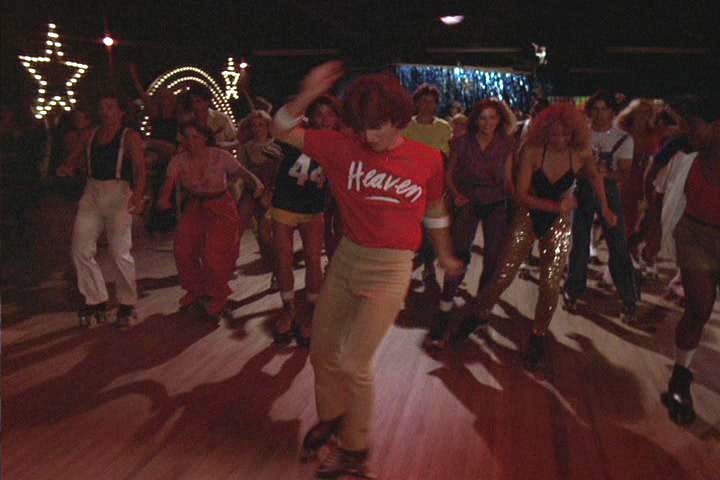
Like all pop culture fads it was not long before cinema responded to the culture of roller-skating in an effort to quickly cash in and so the roller disco movie was unveiled and three films were quickly produced - Skatetown USA (1979), Roller Boogie (1979), and Xanadu (1980). There had already been films with roller skating sequences such as Shall We Dance (1937) and a few films about roller derby like Kansas City Bomber (1972) starring Raquel Welch but nothing until these three films were about roller-skating as culture. However, the experience of pleasure and speed through roller-skating explored in the first part is really quite difficult for cinema to convey since it’s an embodied feeling rather than something tangible that can be represented in the image like say the thrill of a car chase; in filmic terms we would say that speed is non-indexical. Therefore, the feeling of being liberated through the experience of movement is not something that can be properly signified but the roller-skating films do try to produce for us a feeling of transcendence that equates to the feeling we might imagine the onscreen skaters are experiencing. Cinema thus has to try and create ways in which the speed and pleasure associated with roller-skating can be conveyed to the spectator as transcendent and utopian.

One of the key influences on thinking through this aspect of the topic is Richard Dyer’ s ‘Entertainment and Utopia’ from 1977 (in the collection Only Entertainment). For Dyer, forms of entertainment such as musicals help us escape from the everyday, to quote ‘alternatives, hopes, wishes – these are the stuff of utopia, the sense that things could be better, that something other that what is can be imaged and maybe realized’. While Dyer suggests that entertainment does not really present us with models of a utopian world, rather a text’s utopianism is contained in the feelings it creates for us – the function of certain forms of entertainment like the roller skating movie is to present how a utopia on skates might feel rather than how it might be organised and brought about. Furthermore, in Dyer’s argument utopian qualities (also like that of speed) are often beyond the realm of representation in things such as colour, sound, movement, rhythm, and camerawork all of which are integral components of the roller movie.

While Skatetown USA and Roller Boogie attempt to capture a skaters’ paradise they ultimately fail to suggests what one might do with that utopia now that its reached, and so what begins as an experience of social and gender liberation through speed, is ultimately ground to a halt through the conventions of romantic plotting and an attempt to shoehorn the roller skating picture into the then out-dated romantic conventions of the Hollywood musical. Both films begin with a representation of skater’s utopia but end with the formation of a couple and the loss of the utopian community and symbolically the loss of the female skater’s independence. Her freeform skating style that began as unique bodily expression is soon quashed in favour of a traditional romantic pairing in which she follows the man’s lead in what is effectively a ballroom dance version of roller-skating as she no longer harnesses her own speed but has to willingly depend on the momentum and energy generated by her male partner.

Yet, the opening of Skatetown USA comes as close as possible in capturing the look and the feel of a utopian space; it’s one of the most exciting first five minutes of any movie. Importantly, intensity is created through not just what is onscreen but also what is heard (Patrick Hernandez’s amazing disco stomper Born to be Alive) and how that seeing is in effect organised through highly unusual editing patterns. The film’s opening sequence also draws upon the iconography of science fiction and fantasy in order to render roller-skating and Skatetown as literally out of this world. The editing is unconventional involving at first match cuts and jump cuts on the skater’s body (accompanied by a synthesized popping noise) but also another kind of editing eschewed in Hollywood and mostly used in experimental and avant-garde cinema called strobe cutting. Strobe cutting, in which portions of movement are missing, actually make it appear as if the skating is faster than what the camera can actually capture thus expressing through film those non-indexical sensations of speed.

Like Roller Boogie the film draws on oppositions between the earthly and the otherworldly, transcendent speed and grounded immanence, which, when we think about these films as forms of the musical, is the narrative/numbers tension. This other world, not the utopia but not a dystopia either, is that of the narrative defined as the everyday of work, domesticity and family and where young people are confronted by reality, rules and restrictions. The narrative aspects of these films really slow down the energy and speed associated with skating with deadening immanence; the plot literally grinds skating to a halt since skates are never worn indoors. The romantic scenes, key to the narrative and the formation of the couple (what in the musical is called the dual focus structure), are also off-skate sequences with down tempo music; often removing all other skaters from the scene. Romance becomes exclusive and intimate and seems to be oppositional to the all-inclusive skating utopia suggested at the start of the film. The finale to Roller Boogie also reveals how this dilemma plays out in a conventional manner since the narrative/numbers tension is really something the film cannot work out because of the way the skating numbers are difficult to integrate and progress the narrative component. Therefore, the film ends with recourse to conventional structures of dancing (on skates of course) in which the heterosexual pairing produces movement based on a powerful visual and physical difference in gender that’s more strictly come dancing than skater’s paradise.

I’ll finish here with one critique open for debate that goes something like this - when the woman allows the man to lead in dancing (emulated here on skates) this lays the foundations for an eventual and ongoing gender disparity – letting the man lead and depending on the man for physical support during dancing and skating is a way of establishing a first instance of dependency through movement and the body that may pave the way for other forms of support, i.e. economic. Certain forms of dancing (mimicked in the roller skating pair-off finale) can also be used to regulate gender and sexuality in normative ways and when one gender has to assume the lead and the other gender follows we see in its very logic how inequality is fashioned through pleasure. Its no surprise that these film offer the perfect bridge between the 1970s and the 1980s (a tension they perhaps try to work through) as liberation dissipates in pleasures experienced in wholly solipsistic and apolitical terms.

(photo credits susan miller: permissions)

Monday, 6 April 2009

The culture and politics of roller skating.

Roller discos are back! Most of the main UK cities now offer monthly roller disco nights as an alternative to clubbing. Despite tapping into a day-glo nostalgia for the 1980s (mainly for those to young to remember that decade) the roller disco is really a product of the 1970s. Here Gary Needham explores the culture and politics of the original roller disco culture and its relationship to liberation politics.

PART 1.
One of my current research interests is concerned with the cultural politics of speed and how the experience of speed in the 1970s enabled the production a kind of utopian movement for two oppressed groups; women and gays. In particular, I’m thinking about the relationship between roller skating culture and 1970s liberation politics – how the act of skating and the pleasures of skating can be conceived of as an expression or consequence of a political shift that is embodied through the pleasure of speed, here produced in roller skating activities – the freedom of four wheels is also about freedom in political terms; sexual revolution becomes the revolution of the skater’s wheel; freedom to be yourself (as in gay liberation); freedom from oppressive structures (as in women’s liberation) – thus I want to consider the sense in which these two political revolutions, the women’s movement and the gay movements of the 1970s, literally involve physical, pleasurable and sensational experiences of moving and mobility. Therefore, I want to propose the idea that the emergence of a roller skating phenomenon or craze in the mid to late 1970s, especially among women and gay men, can potentially be read as symptomatic of other process of movement in politics; liberation politics are conceived of in terms of the freedom to move and be seen enjoying the pleasures of movement - the speed of the movement, velocity and energy, the outcome of which is pleasure in varying degrees of intensity can be read politically.
This suggestion is also rooted in need to map out the pleasures of speed in relation to feminist and gay politics; speed as something that is also relevant and essential to thinking about (old fashioned) identity politics and representational strategies; speed as something that can be embodied or at least allows one of its affects to be an embodied pleasure that relates to how one feels gendered and sexually orientated (orientation the word itself suggests a movement to get into the right position or place). I am not arguing that roller-skating is a political activity (although it has been used for breast cancer and AIDS fund raising), or that being on skates one somehow feels feminist rather, I’m suggesting that skating is related to a kind of latent political feeling that things were getting better and moving in a forward direction, that is, the politics of liberation has momentum for gender and sexuality and this can be experienced directly in the body’s actual freedom through movement.

In the experience of roller skating speed is harnessed for speed’s sake. Speed is the consequence of going fast. It is not about getting somewhere or someplace quicker and although it can be used as a method of transport it is more often not. A destination is not the outcome of speed in this instance; speed is not goal orientated, the goal is movement in itself. Speed which is often associated with labour and productivity is here allied to pleasure not product. Emphasis would seem to be on ‘being in the process of speed’, pleasure in movement for the sake of itself. Roller skating produces a form of pleasure in speed that is rapturous, transcendent and liberating because that’s all it needs to be.

Part of this research is also response to the way in which speed is often aligned with masculinity, modernity and certain ways of theorising speed that are implicitly masculine in their undertaking, discursively speaking. Even as a generalisation, in popular culture the car-chase is often constructed as a specifically male pleasure of the cinema and speed is often experienced in ways that have a tendency to favour masculinity; in general things that go fast are often thought to fascinate boys. This implicit gendered division can often be seen in the way female students often guffaw at their male peers extolling of the pleasures of Top Gear. Technologies of speed are often coded as masculine or made readily available to men and the harnessing of speed (in the film of the same name) becomes another macho narrative of mastery and control. In addition to this there is a long history of anxieties around women’s mobility that dates back to the suffragettes on their bicycles and women’s unprecedented visibility in moving through public space (the underlying subject on an early silent film called Traffic in Souls uses the theme of white slavery to keep girls indoors). In The Wizard of Oz we should know Miss Gulch is the wicked witch because during the tornado her bicycle transforms in to a broom as she transforms from spinster to witch; a symbolic precursor for the dykes on bikes movement. Despite being an oversimplification one of the consequences of patriarchy is to restrict and control the movement and mobility of women in order to maintain distinctly gendered division between the private and the public, home and work, masculine and feminine, productivity and leisure. In short, speed and movement have political implications that are intimately tied to gendered and sexual identities. The emergence of roller skating as a phenomenon in the 1970s seems to be a particular liberatory response to a long history of anxieties and pleasures around movement, speed, the body and identity.

In Part 2 Gary Needham examines the roller disco movie.

(Photo credit Hilly Blue: permissions)